
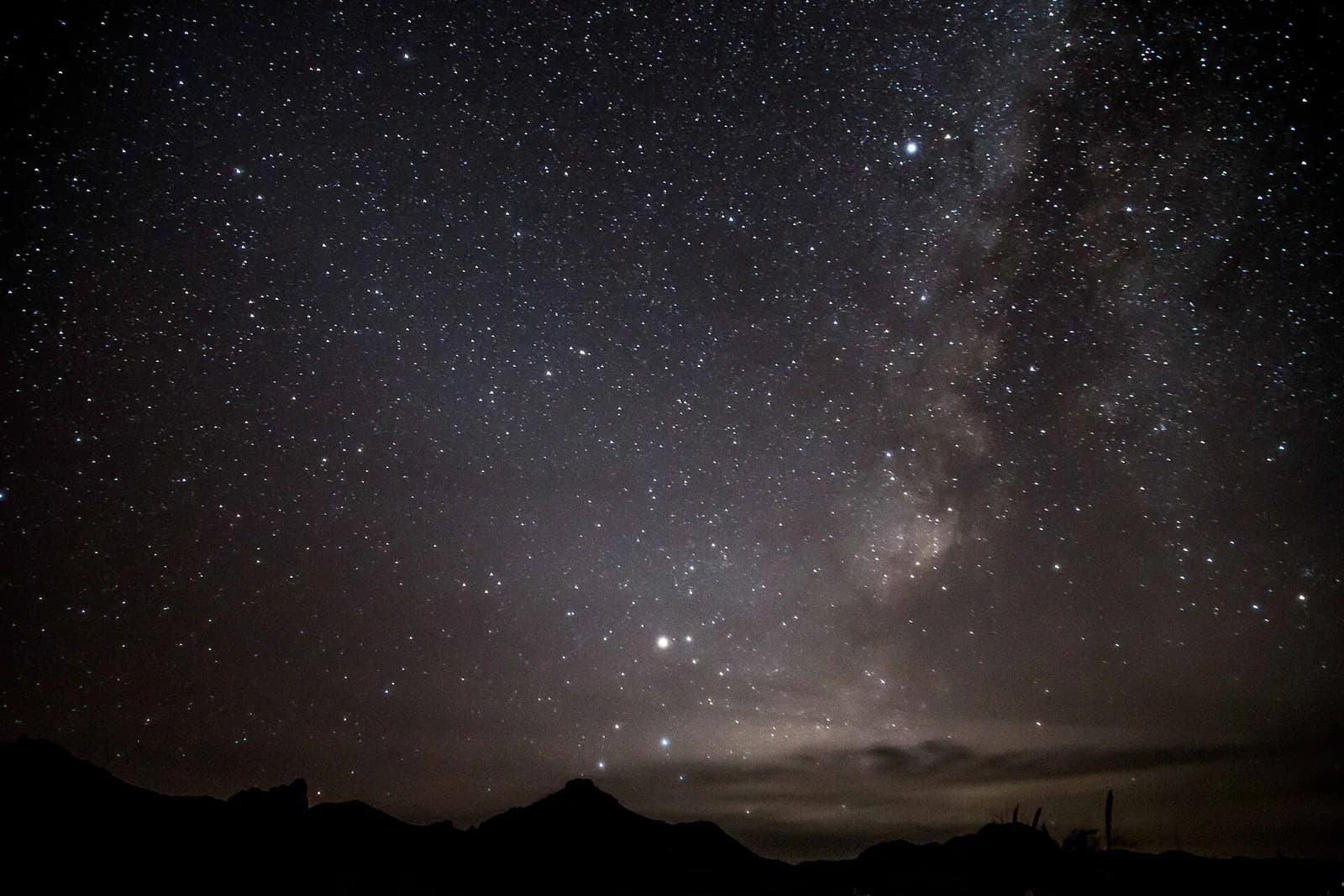
What makes Big Bend a strong stargazing destination?
Big Bend can reward a night planned specifically for stargazing. On a clear, low-Moon night, the park can show you a far denser star field and much less artificial skyglow than a city or suburb. The catch is distance. Fuel, water, road conditions and a legal place to sleep matter almost as much as the forecast. For a first visit, choose an NPS viewing area whose route you have confirmed on the official park map, and arrive before dark. Plan Big Bend when you want a genuinely dark desert sky and are prepared for limited services and weak cell coverage. Avoid relying on a marginal forecast or improvising after arrival.
The Star Window’s take
- Best for: A dedicated dark-sky trip, Milky Way planning, meteor watching and wide naked-eye views
- Main advantage: Exceptionally dark skies far from major cities
- Main limitation: Long drives, limited services and changing road conditions
- Best first move: Pick an NPS viewing area whose route you have confirmed on the official park map
- Do not assume: A dark-sky designation can overcome clouds, smoke, moonlight or unsafe roads
Are conditions strong enough to consider the trip?
Big Bend requires more preparation than a backyard session. A short clear break may support a brief session for someone already in the park. The Star Window does not assess whether conditions justify a drive because it does not know your origin, route or current access. Before you leave, check two things:
- The sky: Hourly clouds, Moon timing, smoke, haze and the length of the dark window
- The ground: NPS road closures, storm damage, campground status and any travel alerts
A practical decision
Forecast supports a session: The selected forecast point is mostly clear and the Moon stays out of the way for a useful stretch. Confirm current access independently. Limited observing window: Clouds may break for an hour or two, or a bright Moon limits faint objects but leaves planets and constellations worthwhile. Forecast does not support a session: Widespread cloud, smoke, thunderstorms or no useful dark window. Official road and closure information remains a separate check. Big Bend is too remote to let a generic daily weather icon make the decision for you. Use the forecast for the hours you will actually be outside. Next step: Check tonight’s stargazing conditions at Big Bend
Road status matters here. Storms can close primitive roads and backcountry campsites with little relevance to the sky forecast. Check the official NPS conditions page before choosing any unpaved route.
Where should you stargaze in Big Bend?
The NPS says good night-sky viewing is available throughout the park and names several places to consider. Choose based on where you are staying, current official access information and whether you need paved-road access.
Swipe the table horizontally to view every column.
| Viewing area | Best fit | What is confirmed | What to recheck |
|---|---|---|---|
| Fossil Discovery Exhibit | First visit and straightforward access | NPS-recommended viewing area; confirm the official map route before travel | Road and facility status |
| Sotol Vista | Established overlook on Ross Maxwell Scenic Drive | NPS-recommended location; confirm the official route and current conditions | Road, wind and weather conditions |
| Dugout Wells | Visitors staying on the eastern side of the park | NPS-recommended viewing location | Parking and current access details |
| Backcountry campsite | Experienced visitors with the correct permit and vehicle | Many campsites offer dark viewing | Reservation, road closure and vehicle requirements |
How to choose
For a first trip, start with the Fossil Discovery Exhibit or Sotol Vista because they give you a named destination and a route you can confirm before dark. Dugout Wells may be more convenient from the eastern side of the park. Backcountry campsites can be darker, but they add permits, reservations and vehicle questions. Save them for a trip built around backcountry access—not as a last-minute attempt to improve an already dark sky.
What will the sky actually look like?
Once your eyes adjust at Big Bend, the empty patches between familiar constellations begin to fill with stars. Under strong conditions, the Milky Way may appear as a pale band with uneven brightness and darker lanes. It will not look like a processed photograph. Cameras collect light for seconds or minutes and reveal color and detail your eyes do not see in the same way. The exact sky changes by date and time. Bright planets may be visible when they are above the horizon. Meteors may appear on any clear night and become more frequent during active showers. The Milky Way’s brighter center is seasonal.
What you can expect by equipment
Naked eye: Big Bend’s biggest advantage. You can follow constellations, see a dense star field, watch for meteors and, in season, trace the Milky Way. Binoculars: More stars, brighter clusters and richer Milky Way fields without a complicated setup. Telescope: Better for selected targets than for the whole sky. Bring one only if you can set it up safely and keep lights under control. Camera: More color and Milky Way structure than the eye can see. Long-exposure images should always be labeled as photographs, not naked-eye previews. Give your eyes about 20–30 minutes away from white light. A dim red light helps, but even red light should stay pointed down and used only when needed.
What can ruin the visit?
A bright Moon
Moonlight washes out faint stars and the Milky Way. It does not ruin every target. The Moon itself, bright planets and the desert under moonlight can still make the night worthwhile.
Clouds, smoke and dust
A “clear” forecast can still produce weak contrast when smoke, haze or dust sits in the air. This is where transparency matters: it simply means how cleanly light passes through the atmosphere.
The wrong road
Big Bend’s primitive roads are not interchangeable with paved park roads. Storms can change them quickly. A map app showing a route does not prove your vehicle should take it.
Heat and distance
A nighttime visit still includes daytime driving, fuel planning and the possibility of a vehicle problem far from help. Summer temperatures can remain serious after sunset.
A poor overnight plan
Stargazing access does not give you permission to sleep in a parking area. Reserve a campground, legal backcountry site or lodging before you go.
Access, hours, parking and camping
Is Big Bend open at night?
Yes. NPS operating-hours guidance says Big Bend’s entrances are open 24 hours a day throughout the year. Visitor centers and entrance stations keep separate schedules, so staff may not be available when you arrive.
Do you need to pay an entrance fee?
Yes. An entrance pass is required. Because prices and payment methods can change, check the official NPS fee page before you go.
Where can you park?
Use established parking areas and official pullouts. Do not stop in a travel lane, drive off-road or create a new parking spot to gain a slightly darker view.
Can you sleep where you stargaze?
Do not assume so. Parking for a viewing session is not the same as camping permission. Developed campgrounds require reservations, and backcountry camping follows separate rules.
What should you know about arriving after hours?
You may enter after staffed facilities close, but you should already have your map, fuel, pass and overnight plan. Cell coverage is limited, and help may be far away.
Safety and final checks
Big Bend is remote enough that a missed turn, low fuel tank or weak water supply can become the real story of the night. Before you leave:
- Check hourly clouds, Moon timing and the NPS conditions page.
- Choose one exact viewing area and confirm the route.
- Fill the tank, carry water and save the map offline.
- Confirm legal lodging or camping.
- Bring a dim red light, closed-toe shoes and an emergency layer.
- Share your route and return time.
What should you do if conditions change?
If your first location is crowded or affected by a local cloud bank, compare another official paved-road option inside Big Bend. Do not turn an inconvenience into an unsafe roadside search. Big Bend Ranch State Park is another major dark-sky destination in the region, but it has separate Texas State Parks rules, fees and access details. Treat it as a different trip and verify its official information before using it as a backup. For a broader comparison, see the Texas stargazing page and state map.
Frequently asked questions
Is Big Bend good for stargazing?
Yes. Its distance from large cities creates exceptionally dark skies. The trip still depends on clouds, Moon timing, smoke and safe road access.
Can you enter Big Bend at night?
Yes. The park entrances are open 24 hours a day. Visitor centers and entrance stations keep separate schedules, and an entrance fee still applies.
Where should a first-time visitor stargaze?
Start with an NPS-recommended location reached from a paved road, such as the Fossil Discovery Exhibit or Sotol Vista. Confirm current access before leaving.
Can you see the Milky Way at Big Bend?
Yes, when the relevant part of the Milky Way is above the horizon and the sky is clear, dark and low in moonlight. Its brighter center is seasonal.
Do you need a telescope?
No. Big Bend is strongest as a naked-eye destination. Binoculars are an easy upgrade, while a telescope is optional and better for selected targets.
Can you sleep in a stargazing parking area?
Do not assume so. Use a reserved campground, legal backcountry site or lodging. A late viewing session does not create camping permission.
Does a full Moon ruin the trip?
It weakens the Milky Way and faint stars. Bright planets, constellations, the Moon and the moonlit desert can still be worth seeing.
Is Big Bend safe for solo stargazing?
A careful solo visit to an established area can be reasonable, but remoteness and weak cell coverage raise the risk. Share your route, stay near the vehicle and avoid roads beyond your equipment or experience.
Official sources
- Big Bend NPS — Night Skies and Stargazing
- Big Bend NPS — View the Night Sky
- Big Bend NPS — Operating Hours and Seasons
- Big Bend NPS — Fees and Passes
- Big Bend NPS — Alerts and Conditions
- Big Bend NPS — Basic Information
- Big Bend NPS — Maps
- Texas State Parks — Big Bend Ranch State Park
- National Park Service — Astronomy
Source check completed July 28, 2026. Hours, fees, road status, campground availability and alerts should be checked again before travel.