
How should you choose a Joshua Tree stargazing area?
Joshua Tree offers four NPS-listed parking areas for night-sky viewing. NPS also notes that nearby communities affect the park's sky and identifies Pinto Basin Road as the least-trafficked and darkest corridor. Pick your location before sunset. Use a designated area or established pullout rather than deciding after dark that an unmarked shoulder looks suitable.
What this guide can support
- Best for: A first desert stargazing trip, short Southern California getaways and night photography
- Main advantage: 24-hour park access and four official stargazing lots
- Main limitation: Crowds, vehicle lights, weak cell service and changing conditions across a large park
- Darkest official direction: Pinto Basin Road toward Cottonwood
- Important rule: No sleeping or camping in roadside lots or parking areas
Do current conditions support a session?
Joshua Tree covers a large area and a wide range of elevations. A forecast for one part of the park may not match the weather at another. Check the sky for the exact area you plan to use:
- Hourly clouds
- Moonrise, moonset and illumination
- Smoke, dust and wind
- The start of full darkness
- Temperature after sunset
Then check NPS alerts for roads, flooding, fire restrictions or closures.
A practical decision
Go: The selected part of the park is mostly clear, the Moon leaves a useful dark window, and there are no major access alerts. Go for a shorter session: The Moon is bright or clouds come and go, but you are nearby and still want bright stars, planets or moonlit desert scenery. Choose another night: Heavy cloud, wildfire smoke, dangerous wind, flash-flood risk or no useful viewing window. A useful clear interval can support a session. A narrow or uncertain window does not imply that the rest of the night will stay clear. Next step: Check tonight’s stargazing conditions at Joshua Tree
Use the forecast for your chosen area. The park spans a large elevation range, so a generic park-center forecast can miss real differences in cloud, wind and temperature. Check the current NPS alerts and conditions before you leave.
Where should you stargaze in Joshua Tree?
NPS designates four parking lots for stargazing and also allows viewing from established roadside pullouts. At the designated areas, you must stay awake and remain within 20 feet, or 6 meters, of your vehicle.
Swipe the table horizontally to view every column.
| Area | Best fit | What is confirmed | What to know |
|---|---|---|---|
| Quail Springs | Visitors entering from the northwest | Official designated stargazing lot | Convenient, but not the park’s darkest corridor |
| Hidden Valley | Central park access | Official designated stargazing lot | Use the signed lot and confirm current access before travel |
| Cap Rock | Short session near the central road | Official designated stargazing lot | Use the signed stargazing lot, not nearby Day Use Only areas |
| Ryan Mountain | Another central-park option | Official designated stargazing lot | The parking area is the viewing option; the trail requires separate planning |
| Pinto Basin Road pullouts | Darker skies and lower traffic | NPS identifies the corridor between Cholla Cactus Garden and Cottonwood as darkest | Use only established pullouts and stay close to the vehicle |
| Cottonwood Campground | Legal overnight stay | NPS identifies it as the darkest campground | A campsite is required; not every site has a clear horizon |
How to choose
Use Quail Springs when northwest-entry convenience matters. Hidden Valley, Cap Rock and Ryan Mountain keep you near the central park road. Choose the exact signed stargazing lot—especially at Cap Rock, where nearby Day Use Only areas follow different rules. For darker skies, NPS points to established pullouts along Pinto Basin Road. Cottonwood is the park’s darkest campground when you need a legal overnight stay.
What will the sky actually look like?
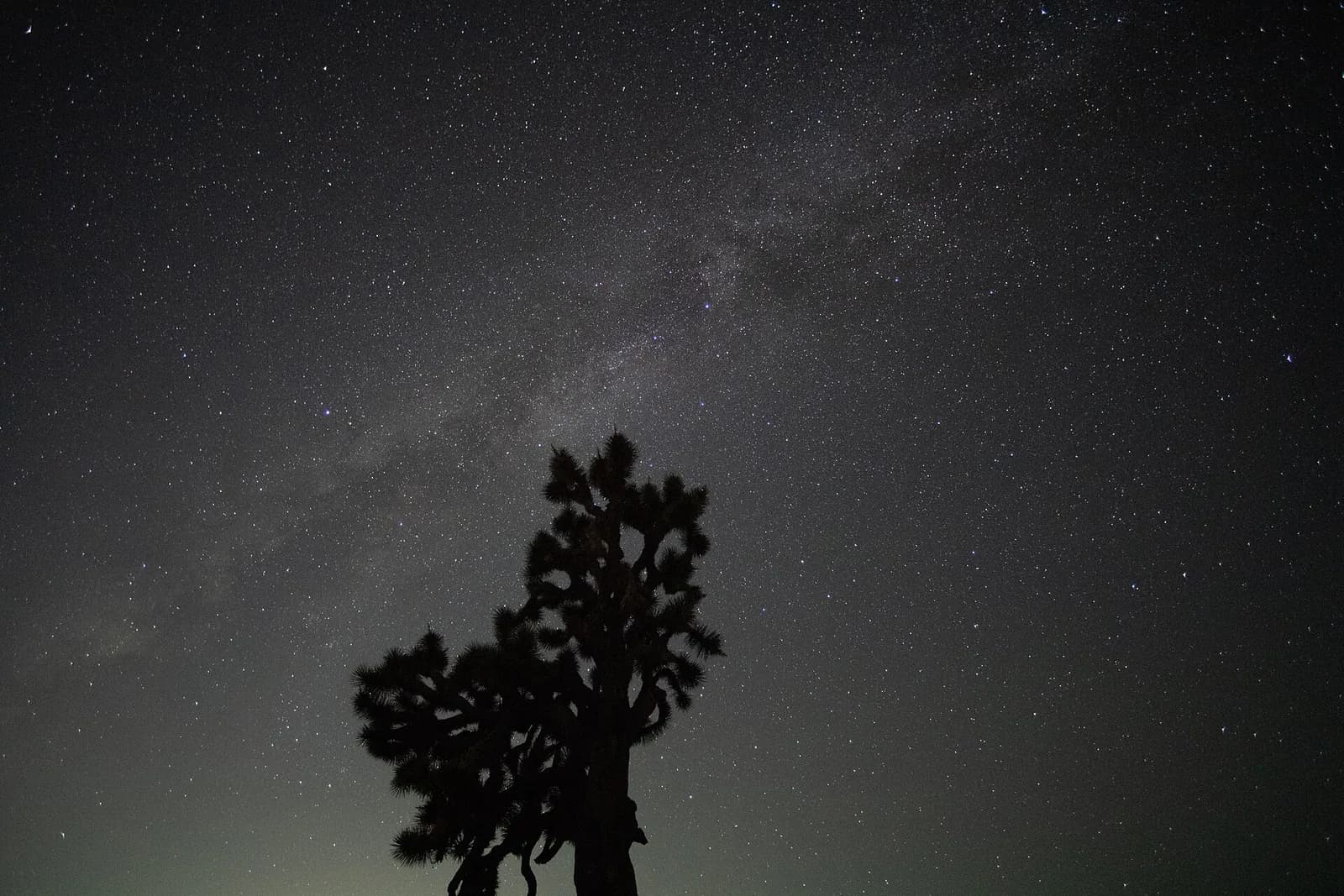
On a good night, Joshua Tree can feel dramatically darker than the Los Angeles basin. Once your eyes adjust, more stars fill the space around familiar constellations. The Milky Way may appear as a pale band on a moonless summer night when the brighter section is above the horizon. That is the current NPS seasonal guidance. For a date-specific answer, use the Milky Way planner rather than assuming the view will be the same every month. Vehicle headlights and nearby phone screens can undo dark adaptation quickly. Even in a dark park, the people around you can change the experience.
What you can expect by equipment
Naked eye: The best way to take in the broad sky, constellations and meteors. Binoculars: More stars and brighter clusters with almost no setup. Telescope: Useful for selected objects, but harder to manage in a busy parking lot. Camera: Strong foregrounds, including Joshua trees and boulders. Long exposures reveal more color than your eyes will see. NPS does not allow light painting. Do not use bright flashlights, strobes or sweeping beams to illuminate trees and rocks for a photograph.
What can ruin the visit?
The wrong part of the park
A convenient northern lot may be easier, while Pinto Basin may be darker. Choose based on your goal rather than assuming every area offers the same sky.
A bright Moon
Moonlight weakens the Milky Way and faint stars. It can still make Joshua trees and rock formations look striking and leave bright planets worth seeing.
Crowds and headlights
A clear night can still feel disappointing when cars come and go. Set up away from traffic paths and keep your own lights low.
Smoke, dust and wind
Thin smoke or dust can flatten the sky even with no solid cloud layer. Wind can also make a telescope or tripod frustrating to use.
Sleeping plans
You may stay awake and observe in designated areas. You may not turn a parking lot into a campsite or sleep in the vehicle there.
Access, hours, parking and camping
Is Joshua Tree open at night?
Yes. NPS operating-hours guidance says the park is open 24 hours a day, every day of the year. Entrance gates remain open after staffed stations close. Individual Day Use Only areas still close from dusk to dawn. The park being open does not mean every picnic area, trailhead or facility is available overnight.
Is there an entrance fee?
Yes. Check the current NPS fee page before you go. Save any digital pass to your phone before entering because reception is limited.
Do you need a reservation to stargaze?
The NPS stargazing activity page does not list a reservation requirement. Camping, special programs and other activities have separate rules.
Where can you park?
Use one of the four designated stargazing lots or a true established pullout. Stay awake and remain within 20 feet of your vehicle where the NPS rule applies.
Can you sleep in the lot?
No. Overnight camping is not allowed along roadsides or in parking lots. Use a legal campground or a properly permitted backcountry site.
Safety and final checks
Pick your lot before sunset. Finding a signed area in fading light is much easier than judging desert shoulders in full darkness. Before you leave:
- Check the forecast for the exact part of the park and review NPS conditions.
- Save the map and pass offline.
- Fill the tank and bring water, food and warm layers.
- Confirm legal camping or lodging.
- Bring a dim red light and leave light-painting equipment at home.
- Share your location and return time.
Do not rely on cell service for navigation or a last-minute change of plan.
What should you do if conditions change?
If a central lot is crowded, consider a legal pullout along Pinto Basin Road or a reserved stay at Cottonwood Campground. Confirm current conditions before making the longer drive south. For a broader choice, compare Joshua Tree with Death Valley and other California destinations on the state page and map.
Frequently asked questions
Is Joshua Tree good for stargazing?
Yes. It offers dark desert skies, official stargazing lots and 24-hour access. For the darkest officially identified corridor, NPS points to Pinto Basin Road between Cholla Cactus Garden and Cottonwood.
Can you enter Joshua Tree at night?
Yes. The park stays open 24/7. Signed Day Use Only areas still close from dusk to dawn.
Where should you stargaze?
NPS designates Quail Springs, Hidden Valley, Cap Rock and Ryan Mountain. For darker skies, it points to established pullouts along Pinto Basin Road.
Where is the darkest part of the park?
NPS identifies Pinto Basin Road between Cholla Cactus Garden and Cottonwood as the least-trafficked and darkest corridor. Cottonwood is the darkest campground.
Can you see the Milky Way?
Yes, on clear, moonless summer nights when the brighter part is above the horizon. Use a date-specific planner for the exact timing.
Can you sleep in a stargazing lot?
No. Parking areas and roadside pullouts are not campsites. Reserve a campground or use a legal backcountry site.
Is light painting allowed?
No. NPS says light painting is not permitted in Joshua Tree National Park.
Do you need a telescope?
No. The park is strong for naked-eye viewing. Binoculars are useful and easy, while a telescope is optional.
Does a full Moon ruin the trip?
It weakens the Milky Way and faint stars, but bright objects and moonlit desert scenery can still be worthwhile.
Official sources
- Joshua Tree NPS — Stargazing
- Joshua Tree NPS — Stargazing Activity
- Joshua Tree NPS — Operating Hours and Seasons
- Joshua Tree NPS — Frequently Asked Questions
- Joshua Tree NPS — Fees and Passes
- Joshua Tree NPS — Safety Guidelines
- Joshua Tree NPS — Alerts and Conditions
Source check completed July 28, 2026. Hours, alerts, campground rules, closures and fee details should be checked again before travel.