
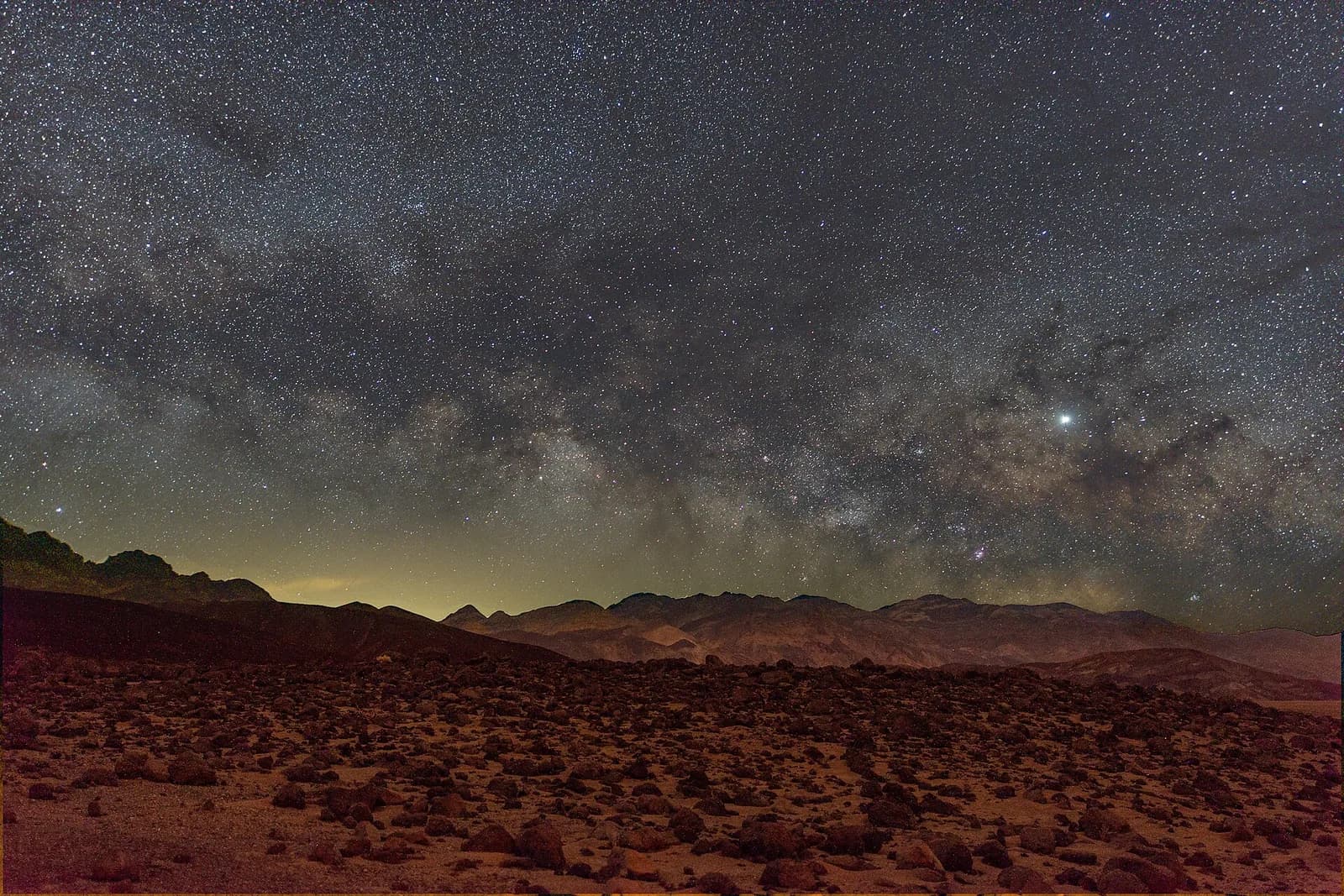
Is Death Valley worth the trip for stargazing?
Death Valley can deliver an exceptional dark-sky experience. It also gives you very little room for a lazy plan. The park never closes, but roads do. Summer nights can stay dangerously hot, cell service is scarce, and mountains can block objects near the horizon. For a first nighttime visit, The Star Window recommends one of the established NPS locations reached from paved roads. When the forecast is clear and the Moon stays low, Death Valley can show a dense sky, a visible Milky Way in season and a desert landscape that feels completely different after dark.
The Star Window’s take
- Best for: Serious dark-sky trips, wide night landscapes and astrophotography
- Main advantage: Gold Tier dark skies and several NPS-recommended locations
- Main limitation: Heat, long distances, road closures and poor cell service
- Best first move: Choose an established paved-road location
- Do not assume: The lowest point or most remote road gives the best view
Are conditions strong enough to consider the trip?
Death Valley needs more than a good cloud forecast. Check the exact location, road status and temperature for the hours you will be there. Before leaving, review:
- Hourly cloud cover
- Moonrise, moonset and illumination
- Smoke, dust and haze
- Wind and storm risk
- Temperature during the drive and viewing window
- NPS road closures and vehicle requirements
A practical decision
Go: The sky is mostly clear, the Moon leaves a useful dark window, the route is open and temperatures are safe for your plan. Use a closer paved location: The sky looks good, but a remote road is uncertain, temperatures remain high or the clear window is short. Choose another night: Heavy cloud, severe heat, smoke, flash-flood risk or a closed route. A Furnace Creek forecast does not automatically describe Ubehebe Crater. Death Valley is too large for one park-wide weather icon. Next step: Check tonight’s stargazing conditions in Death Valley
Roads are part of the forecast here. Open the NPS road-status and conditions page before choosing a viewing area. A clear sky does not make a closed or unsuitable road safe.
Where should you stargaze in Death Valley?
NPS recommends four main night-sky locations and names several additional photography spots. Each offers a different balance of drive time, horizon and foreground.
Swipe the table horizontally to view every column.
| Area | Best fit | What is confirmed | What to know |
|---|---|---|---|
| Mesquite Flat Sand Dunes | Wide landscape and an easy-to-recognize destination | NPS-recommended viewing area near Stovepipe Wells | Walking on sand is harder in darkness |
| Harmony Borax Works | Shorter drive from Furnace Creek and historic foregrounds | NPS-recommended location | Use permitted paths and protect historic structures |
| Badwater Basin | Moonlit landscape and broad overhead sky | NPS-recommended location | Mountains block parts of the low horizon |
| Ubehebe Crater | Visitors prepared for a longer remote drive | NPS-recommended location | Stay back from crater edges and confirm road access |
| Zabriskie Point | Night-landscape photography | NPS identifies it as a common photography location | Visitor lights and terrain may affect setup |
How to choose
Mesquite Flat Sand Dunes gives you the strongest dune foreground, but walking on sand is harder after dark. Harmony Borax Works keeps you closer to Furnace Creek. Badwater works well for broad overhead sky and moonlit landscape, though mountains cut into the low horizon. Ubehebe adds a longer, more remote drive. Zabriskie Point is mainly a photography choice. The Racetrack is not first-visit advice; its rough road and vehicle requirements turn it into a separate backcountry plan.
What will the sky actually look like?
At Death Valley, darkness changes the amount of sky you notice. Familiar constellations sit inside a much denser field of stars. In season, the Milky Way may appear as a pale, uneven band. It will not show the saturated purples, blues and sharp structure seen in long-exposure photography. Terrain still matters. A dark location cannot reveal an object hidden behind a mountain or below the horizon.
What you can expect by equipment
Naked eye: The broad star field, constellations, meteors and the Milky Way in season. Binoculars: More stars and brighter clusters without a large setup. Telescope: Better for chosen targets, but wind, dust and unstable air may limit high magnification. Camera: One of the park’s strengths. Dunes, salt flats, historic sites and ridges can create strong foregrounds. Cameras show color the eye will not see in the same way. Give your eyes about 20–30 minutes away from white light. Use red light sparingly.
What can ruin the visit?
Heat
Summer heat is the first planning question, not a footnote. NPS says daytime temperatures can approach 130°F, and nights may remain near 90°F. A sunset departure does not erase the heat absorbed by the road, vehicle and desert.
The wrong horizon
Badwater may be visually dramatic but weak for an object close to the horizon. Match the site to the sky target.
A closed road
Floods and storm damage can change access. Check the official road map shortly before leaving.
Smoke, dust and haze
A cloud-free sky can still look flat. Dust and smoke reduce atmospheric clarity and hide faint Milky Way detail.
A bright Moon
Moonlight weakens faint objects but can transform the dunes, salt flats and ridges. A full-Moon trip can still be worthwhile when the landscape is part of the goal.
Access, hours, parking and camping
Is Death Valley open at night?
Yes. NPS operating-hours guidance says Death Valley National Park is open 24 hours a day throughout the year. Roads, facilities and specific areas can still close.
Is there an entrance fee?
Yes. Check the current NPS fee page before you go.
Where can you park?
Use established parking areas and legal roadside pullouts. Keep the entire vehicle out of the travel lane. Do not drive onto the desert surface to make a viewing spot. The NPS night-exploration page notes that photographers commonly use major-road locations where stopping is otherwise legal and safe. That does not create permission to camp there.
Can you sleep in a pullout?
Camping along paved roads is prohibited. Use legal lodging, a campground or a backcountry location that meets the current rules.
Safety and final checks
Death Valley is large enough that a vehicle problem can become the main event. For a first night visit, an established location near Furnace Creek or Stovepipe Wells is usually smarter than a famous remote photo spot. Before you leave:
- Check clouds, Moon timing, smoke, wind, temperature and the NPS road-status page.
- Choose one location and confirm the whole route fits your vehicle.
- Fill the tank and carry the NPS-recommended water supply, plus emergency food and a blanket.
- Save maps offline and share your route and return time.
- Confirm legal lodging or camping.
- Bring a dim red light and closed-toe shoes.
Stay with a disabled vehicle unless the location creates immediate danger.
What should you do if conditions change?
If Ubehebe or another distant location adds too much risk, stay closer to the developed corridor. Harmony Borax Works, Zabriskie Point and Mesquite Flat Sand Dunes are easier to reach from the main visitor areas, subject to current access. Joshua Tree is not an immediate same-evening backup. Treat it as a separate California desert trip and compare it for another night rather than improvising a long reroute after dark.
Frequently asked questions
Is Death Valley good for stargazing?
Yes. It has Gold Tier dark skies, 24-hour park access and several official viewing locations. Roads, heat, Moon timing and weather still decide whether a specific night is worth the trip.
Is Death Valley open at night?
Yes. The park is open 24 hours a day. Individual roads and facilities may close.
Where should a first-time visitor go?
Choose an NPS-recommended paved-road location such as Harmony Borax Works, Mesquite Flat Sand Dunes, Badwater Basin or Ubehebe Crater, depending on drive time and road status.
Is Badwater Basin the best spot?
Not for every goal. It offers a broad landscape, but mountains block parts of the low horizon. It works better for overhead viewing and night landscapes than for every low target.
Can you see the Milky Way?
Yes, when it is seasonally above the horizon and the sky is clear, dark and low in moonlight. Use a date-specific planner for timing.
Can you sleep in a roadside pullout?
No. Camping along paved roads is prohibited. Use a campground, lodging or a qualifying backcountry location.
Do you need a telescope?
No. Death Valley is strong for naked-eye viewing. Binoculars are an easy addition, while a telescope is optional.
Does a full Moon ruin the trip?
It weakens faint stars and the Milky Way, but it can create excellent moonlit views of dunes, salt flats and ridges.
Is Death Valley safe at night?
A planned visit to an established area can be reasonable. Heat, remoteness, poor cell service, flash floods and road hazards raise the consequences of mistakes.
Official sources
- Death Valley NPS — Night Exploration
- Death Valley NPS — Experience Death Valley at Night
- Death Valley NPS — Operating Hours and Seasons
- Death Valley NPS — Alerts and Conditions
- Death Valley NPS — Safety
- Death Valley NPS — Directions and Transportation
- Death Valley NPS — First-Time Visitor Information
- Death Valley NPS — Fees and Passes
- Death Valley NPS — Rules and Regulations
Source check completed July 28, 2026. Roads, alerts, temperatures, campground rules and fees should be checked again before travel.